


Christmas Hill
Christmas Hill is an urban nature sanctuary in Saanich, BC, featuring a glaciated 109-meter summit, rare endangered Garry oak ecosystems, and vibrant spring wildflower meadows rooted in deep Indigenous history.



Location
Saanich
About
Welcome to Christmas Hill, a pristine 14.5-hectare (36-acre) slice of the Swan Lake Christmas Hill Nature Sanctuary. Rising 109 meters above sea level (a 97-meter climb from the lake surface) this majestic scoured rock summit offers a peaceful sanctuary from the surrounding urban bustle.
Whether you are here to marvel at spring wildflowers, catch a glimpse of migrating birds, or stand on a piece of ancient glacial history, Christmas Hill offers a restorative escape into one of British Columbia's rarest habitats.
Exploring the hill: Visitor info & trails
Christmas Hill is notable for being one of the very few Garry oak-forested hilltops in the Greater Victoria area with no road access. Getting to the top requires a hike up its 1.7 kilometers of trails, which feature some significant stone stairways.
The trail loops
The inner loop: Takes you directly to the summit for a stunning 360-degree panoramic view. Look south to see the city of Victoria, east to PKOLS/Mount Doug, north across the Saanich Peninsula, and west to the rugged Sooke hills. This loop also guides you to a beautiful south-facing viewpoint overlooking Swan Lake.
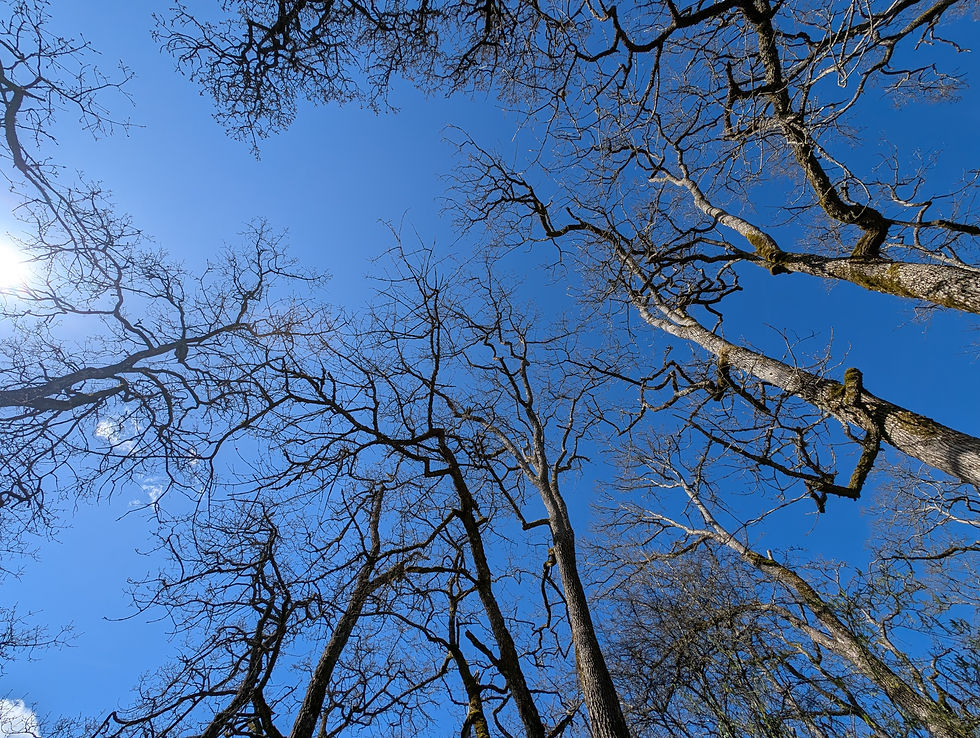
The outer loop: Partially named Byron’s Trail, in memory of a dedicated young man who painstakingly placed hundreds of large stone steps by hand, this trail skirts the east, north, and west slopes. It winds through a rare, deep-soil ecosystem where massive Garry oaks and Douglas-firs tower overhead.
Essential visitor guidelines
Accessibility: The trails feature uneven rocks and steep stone steps; they are not considered universally accessible. Bring sturdy walking shoes and dress for the shifting Pacific Northwest weather.
Parking: There is no formal vehicle parking around the hill itself (only limited on-street parking on Nicholson Street). Visitors are highly encouraged to park at the main Swan Lake Nature House lot and walk the scenic Nelthorpe Corridor connecting trail. A round trip from the parking lot to the summit via the inner loop is 2.5 kilometers.
Birdwatching: The hill is a premier, year-round birdwatching destination. Keep your eyes peeled and your binoculars ready for species like the Townsend's Solitaire, Western Wood-Pewee, Great Horned Owl, and Chipping Sparrow, especially during spring and autumn migrations.
STICK TO FORMAL TRAILS: Going off-trail tramples delicate vegetation and compacts the shallow soil, making it impossible for native plants to re-grow. Please exercise extreme care in this highly sensitive environment.
The history of Christmas Hill
The landscape and character of Christmas Hill are defined by thousands of years of natural forces, Indigenous stewardship, and colonial agricultural history.
Deep geological history
The unique profile of Christmas Hill was sculpted by at least four major glacial periods over the last million years. As massive sheets of ice slowly ground southward, they climbed smoothly up the hill's northern slope and plucked loose stone from the southern side as they exited. This created a classic "ice-scoured" landscape: a smooth, rising northern face and an abruptly dropping southern face broken into rocky steps.
If you look closely at the open bedrock just north of the summit, you can see deep, parallel grooves gouged directly into the stone, vivid permanent scars left by rocks dragged deliberately across the hill by moving ice millennia ago.
Indigenous stewardship & the camas culture
Long before European contact, the rocky, Garry oak-forested slopes of Christmas Hill were a vital landscape for the lək̓ʷəŋən (Lekwungen) and the W̱JOȽEȽP (Tsartlip), BOḰEĆEN (Pauquachin), SȾÁUTW̱ (Tsawout), W̱SIḴEM (Tseycum), and MÁLEXEȽ (Malahat) First Nations communities. For thousands of years, these lands provided essential resources for food, clothing, shelter, medicine, and ceremony.
The Songhees Peoples actively managed the hillsides to cultivate the camas bulb, a staple carbohydrate in their diet. They utilized sophisticated agricultural techniques, including controlled seasonal burning. This regular, low-intensity fire cleared out choking underbrush and prevented thick forests from overtaking the land, deliberately maintaining the open, sun-drenched meadows that Garry oaks and wildflowers need to thrive.
What's in a name? (The legends of the hill)
For years, European settlers referred to the area simply as "Lake Hill." The official change to "Christmas Hill" is tied to two distinct historical accounts:
The HBC record: According to records from the Saanich Municipality, the hill earned its name when Hudson's Bay Company Factor Joseph William McKay first came across it on Christmas Day in the early 1840s.
The legend of the miracle (1855): Local lore tells a more dramatic story. On Christmas Eve in 1855, a massive bird, believed by the lək̓ʷəŋən people to be the legendary Thunderbird, swooped down near Fort Victoria and carried away a small Indigenous child. A large search party of both settlers and Indigenous community members scoured the region through the night. On Christmas Day, the child was discovered entirely unharmed, playing happily at the top of the hill. In honour of what was celebrated as a Christmas miracle, the community permanently renamed the landmark.
The geographic names for both Swan Lake and Christmas Hill were formally and officially locked into Canadian history by the Geographic Board of Canada on May 1, 1934.
Pioneering and farming era
The mid-19th century brought an era of European settlement and farming that radically reshaped the surrounding valleys:
The McKenzie Sheep Station (1857): Kenneth McKenzie, an employee of the Hudson’s Bay Company who arrived in 1853, established a sprawling sheep station on the western slopes of Christmas Hill. He eventually purchased a massive tract of land running all the way from the summit down into the waters of Swan Lake. In 1866, he built a family farmhouse on the slope, raising livestock and vegetables until his death in 1874. His daughters, Agnes and Wilhelmina, preserved the homestead and lived there until they passed away in the late 1920s.
Chesterlea Farm (1903): In 1886, George Rogers Sr. arrived in Victoria as a tenant farmer. By 1903, he purchased the Von Allman farm on the north side of the hill, eventually naming it Chesterlea Farm. By 1925, his son, George Rogers Jr., expanded the estate into a massive 91-hectare (225-acre) dairy operation.
George Rogers Jr. was widely recognized for his deep love of the natural landscape. In a touching eulogy, legendary Canadian writer Bruce Hutchison noted that Rogers stubbornly refused to cut down the best oak trees, even though leaving them in the middle of his fields made harvesting significantly harder and reduced his crop yields. He also prohibited anyone from touching the wild white lilies growing in his woods, ensuring they multiplied for local children to enjoy. Today, Rogers Elementary School sits on a portion of that historical farm, and nearby roads like Rogers Avenue, Lily Avenue, Genevieve Road, and Chesterlea Road celebrate the family's legacy.
The endangered Garry oak ecosystem
Christmas Hill is a critical stronghold for the highly endangered Garry oak ecosystem, defined as a habitat featuring naturally occurring Garry oaks (the only native oak trees in Western Canada) and the ecological processes that existed prior to European colonization.
The hill boasts two distinct variations of this ecosystem:
Scrub oak / shallow soil: Found across the rocky, exposed summit where hardy, twisted oaks grip tightly to thin layers of earth.
Deep soil ecosystem: Located on the lower north and west slopes, a highly fragile environment where majestic Garry oaks stand alongside massive Douglas-firs.
Species at risk & the vernal pond
The sanctuary grounds support roughly 250 distinct plant species and more than 25 unique plant communities. Among them are seven recognized plant species at risk, including the yellow montane violet, a beautiful, bright flower that is red-listed provincially and designated as endangered nationally.
Nestled in the "saddle" between the main summit and the lake viewpoint is a fragile, fenced-off vernal (seasonal) pond. Formed in a natural rock basin scoured out by glaciers 12,000 years ago, this basin collects winter rainwater and holds it deep into the spring. This creates a highly specialized, hyper-local wetland habitat found nowhere else on the hill. In fact, four of the hill's endangered plant species, the Carolina meadow foxtail, chaffweed, heterocodon, and tall woolly-heads, live exclusively in the micro-communities around this pond. Because of the standing water, the camas lilies in the pond bloom weeks later than their cousins on the dry hillsides.
The war on invasive species
The greatest modern threat to Christmas Hill is the invasion of exotic plant species. By 1983, aggressive Scotch broom had completely choked out the open meadows, decimating native wildflower populations. A massive volunteer clearing effort in 1983 temporarily removed the blanket of broom, but by 1986, millions of dormant seeds hiding in the dirt sprouted back to life, turning the hill into a thick sea of yellow flowers once again. (Broom seeds can remain viable in the soil for up to 25 years!)
Realizing that a quick fix wouldn't work, a systematic, long-term conservation plan was launched in 1991. Staff and dedicated volunteers began clearing small patches of mature broom every year, meticulously pulling up knee-high regrowth before moving on to new areas.
Today, that persistent management continues. Every May, volunteers monitor the hill for the bright yellow blooms of missed seedlings, pulling them from the earth before they can drop new seeds. Alongside battles against English ivy, Himalayan blackberry, spurge laurel (daphne), money plant, English hawthorn, and cyclamen, this 40+ year effort has been a triumphant success. The native ecosystem has successfully rebounded, and every March and April, spectacular carpets of camas lilies, easter lilies, shooting stars, buttercups, and chocolate lilies once again dazzle the senses of everyone who makes the climb.
Plan your visit to Christmas Hill today, and experience the timeless, restorative beauty of one of Saanich's most treasured natural landscapes (source, source and source).
Lands
The District of Saanich lies within the territories of the lək̓ʷəŋən peoples represented by the Songhees and Esquimalt Nations and the W̱SÁNEĆ peoples represented by the Tsartlip, Pauquachin, Tsawout, Tseycum and Malahat Nations.
Amenities
Hiking trails
Viewpoints
Online
Christmas Hill trail @AllTrails.com
Videos