


Tod Inlet
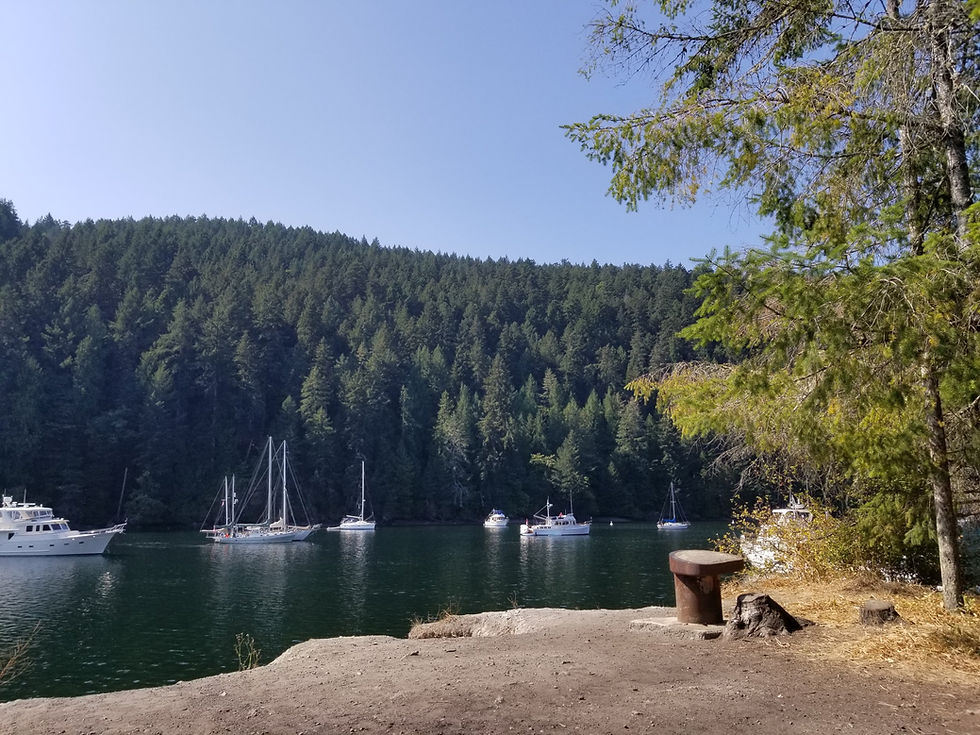
Tod Inlet offers a tranquil escape into southern Vancouver Island’s lush coastal rainforest, inviting visitors to discover a profound cultural landscape shaped by centuries of W̱SÁNEĆ First Nation heritage, early industrial grit, and diverse immigrant legacies.



Location
Central Saanich
About
Tucked away right behind the world-famous Butchart Gardens is one of the Greater Victoria region's best-kept secrets. While thousands of tourists crowd the nearby gardens every year, few realize that a pristine, tree-lined sanctuary sits just steps away (source).
Accessible only by boat or a quiet walking trail, Tod Inlet is a protected sanctuary within Gowlland Tod Provincial Park, one of the last remaining natural green spaces in the region according to the District of Central Saanich.
Indigenous heritage: SṈIDȻEȽ
Long before it was named Tod Inlet by European settlers in 1859, this territory was and remains deeply sacred to the W̱SÁNEĆ (Saanich) First Nation (source).
As documented by the SeaChange Marine Conservation Society, the area is called SṈIDȻEȽ (pronounced 'sneed-kwith'), which translates to "Place of the Blue Grouse”.
In W̱SÁNEĆ oral history, the presence of the blue grouse was a sacred indicator that the land was plentiful and rich in resources. SṈIDȻEȽ marks the very first W̱SÁNEĆ village site, where oral traditions record that the first W̱SÁNEĆ person, SLEMEW̱ (Rain), was placed by the Creator (source).
For centuries, the W̱SÁNEĆ people sustainably gathered edible plants, traditional medicines, and building materials here.
The historic village was tragically burned down in the 1600s by a Haida raiding party, leading the survivors to establish the neighbouring modern-day communities of W̱JOȽEȽP (Tsartlip) and SȾÁUTW̱ (Tsawout).
Today, hikers can still spot ancient shell middens and living, centuries-old culturally modified Western Red Cedar trees along the trail margins (source and source).
The industrial era: The Vancouver Portland Cement Company
The serene landscape changed drastically in the late 1800s and early 1900s when limestone deposits were discovered.
In 1904, pioneer manufacturer Robert Butchart and his wife, Jennie, established the Vancouver Portland Cement Company here, marking the first cement factory built on the west coast of North America, as detailed on the Canadian Register of Historic Places (source).
A bustling industrial footprint quickly grew around the deep, sheltered waters of the inlet, which allowed massive cargo ships to dock.
Raw limestone was transported via an intricate tramline system, clay was mined locally, and coal was shipped in from Nanaimo to fire the massive, 70-foot-long rotary kilns.
When the local limestone deposits were exhausted around 1912, the industrial operation shifted across the Saanich Inlet to Bamberton, and the Tod Inlet plant permanently closed its cement operations in 1921. Left behind was an empty, jagged limestone pit. Jennie Butchart envisioned transforming this industrial scar into a magnificent landscape project, creating what today is the world-famous Butchart Gardens (source and source).
A diverse, segregated working community
The factory brought a surge of diverse immigrant labourers to Central Saanich, creating a complex, strictly segregated company town made up of European managers, alongside large groups of Chinese Canadian and South Asian Sikh workers (source).
Historical accounts from the Canadian Register of Historic Places and historian David Gray's definitive book, Deep and Sheltered Waters: The History of Tod Inlet, reveal a stark division in lifestyle and working conditions:
Living conditions: While white engineers and managers lived with their families in standard company houses, Chinese and Sikh labourers were restricted to communal bunkhouses (housing four to six men each) clustered near an estuary cookhouse (source).
The Chinese village: Over 200 Chinese men lived in a self-made bachelor community during the peak years, growing their own vegetables, raising livestock, and playing mahjong or fan-tan. One notable worker, Yat Tong, arrived in 1912 and spent nearly 50 years at the inlet, eventually staying to work as a trusted gardener for Jennie Butchart well into the 1960s.
The Sikh pioneers: In 1906, 40 Sikh pioneers arrived to work the high-risk positions of kilns stokers and firemen. To replace the heat-exhausted bricks inside the massive 2,700°F rotary tubes, these men entered the blistering kilns with wooden planks strapped to their bare feet for protection (source).
A historic resting place: Due to the severe dust, poor ventilation, and cramped bunkhouses, diseases like tuberculosis and typhus were rampant. Fed up with the toxic conditions, the Sikh workforce collectively left around 1910, but not before honoring their countryman, Tar Gool Singh, who died of consumption. His brother and fellow labourers built a traditional funeral pyre in the Tod Inlet forest, marking one of the very first traditional Sikh cremation ceremonies ever performed in British Columbia (source and source).
Today, nature is actively reclaiming the old factory footprint.
Managed under Gowlland Tod Provincial Park, the extensive trail system directly follows the old footpaths originally cleared by the early Chinese Canadian labourers (source).
Hiking the trail
Getting there: The main trailhead begins off Wallace Drive, near the intersection of Benvenuto Avenue (source).
The walk: A wide, flat gravel pathway follows along Tod Creek, taking roughly 20 minutes to reach the beachfront. Along the way, you will cross a boardwalk underneath an old-growth canopy of Douglas fir, cedar, and hemlock (source).
What to look for: In the spring, the forest floor blooms with wild trilliums and fawn lilies. Keep your eyes open for an old concrete dam built on the creek (rebuilt in 2015 with a dedicated fish ladder for Coho salmon and cutthroat trout). Near the water, moss-covered concrete foundations, abandoned bricks, and a towering, distant factory smokestack peek dramatically through the young poplar and alder trees (source and source).
Paddling and marine life
For kayakers, canoeists, and stand-up paddleboarders, the sheltered waters of Brentwood Bay provide an ideal 5-kilometer round-trip paddle into the inlet:
The launch: Launch from the gravel beach at Verdier Park (located at the end of Verdier Avenue next to the Brentwood Bay ferry terminal). Public washrooms and an unloading loop are available, though street parking is limited.
Rentals: Watercraft rentals are available directly on the water from Pacifica Paddle Sports or the Brentwood Bay Marina.
The route: Paddle out past the marina docks, keep Willis Point to your right, and head left into the inlet past Daphne Island and Butchart Cove.
Wildlife: Depending on the season, paddlers will navigate through thousands of floating jellyfish, while sea stars cling to the intertidal rocks, and bald eagles and Great Blue Herons hunt from the overhanging shoreline branches.
Tip for boaters: On Saturday nights in the summer, Tod Inlet becomes a packed anchorage for local boaters viewing the Butchart Gardens evening fireworks display. If paddling out for the show, ensure you have a headlamp and a 360-degree visible navigation light to safely navigate the crowded marine traffic in the dark.
At the water's edge, park visitors will find a public dinghy dock, a newly restored sandy gravel beach, picnic tables, and pit toilets, offering a perfect, quiet spot to rest and reflect on the deep layers of human history buried beneath the forest (source).
Tod Inlet offers a tranquil escape into southern Vancouver Island’s lush coastal rainforest, inviting visitors to discover a profound cultural landscape shaped by centuries of W̱SÁNEĆ First Nation heritage, early industrial grit, and diverse immigrant legacies.
Lands
W̱SÁNEĆ people which includes W̱JOȽEȽP (Tsartlip) and SȾÁUTW̱ (Tsawout) First Nations
Amenities
Walking trails
Benches
Picnic tables
Pit toilets
Water views
Online
Tod Inlet @VictoriaTrails.com
Tod Inlet @VisitorInVictoria.ca
Tod Inlet @HistoricPlaces.ca
Tod Inlet @WalksInYourBackyard.com
Our History: The Chinese secrets of Tod Inlet @TimesColonist.com
Beyond the Garden’s Wall: The Immigrant Workers of Tod Inlet
The Histories of Tod Inlet @TheBCReview.ca
Videos